
Why One-Time Audits Aren’t Enough: The Case for Continuous Pricing Analysis and Weekly Delivery Monitoring
Most companies treat shipping costs the same way they treat insurance policies:
review once, renegotiate occasionally, and assume everything else stays stable.
But in 2025 (and going into 2026), that mindset is quietly draining budgets.
Carrier pricing structures, delivery performance, surcharges, and even refund eligibility conditions are shifting faster than ever — often with little or no direct notice.
And this is where most shippers fall behind.
They optimize their contract, celebrate the savings…
…and then six months later, their actual cost per shipment is higher than where they started.
Why?
Because a contract is only as strong as the behavior that follows it.
And delivery performance is only as valuable as the visibility behind it.
Today’s environment requires both:
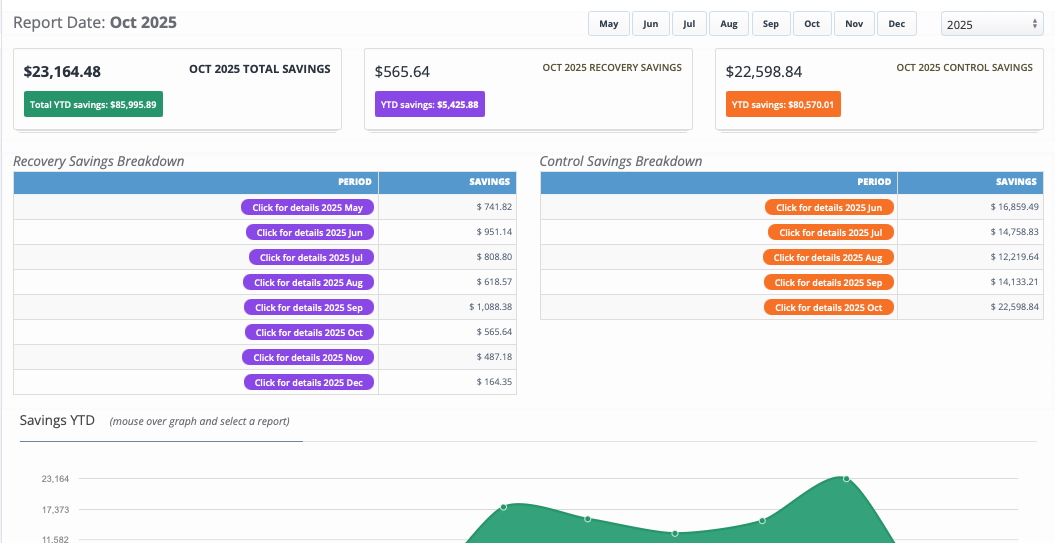
- Continuous pricing analysis (Control)
- Weekly delivery monitoring and refund recovery (Recovery)
When these work together, companies stay ahead of both cost inflation and operational blind spots.
Let’s break down why this matters.
1. Carrier Contracts Are Living Documents — Even If You Don’t Touch Them
Most people think of rate agreements as fixed pricing frameworks.
In reality, they’re living ecosystems with dozens of moving variables:
- Effective discounts vs list rates
- Minimum charges and how they change with your mix
- Surcharges that rise mid-cycle
- Zone-based inflation
- Delivery Area Surcharge creep
- Residential shifts
- First-dollar weight changes
- Incentive tiers that no longer match your actual shipping pattern
A contract signed 14 months ago is often already obsolete — not because it’s “bad,” but because your business and the carrier’s network have both changed.
The result:
Your “discounted” rate may no longer be discounting what you actually ship today.
This is why ongoing cost analysis is no longer optional — it’s your only defense against structural drift.
2. You Can’t Optimize Your Cost Structure if You Don’t Know How You’re Performing
Contract optimization and weekly auditing are tightly connected, even though they’re treated like separate worlds.
Here’s the reality:
- When on-time performance drops, your cost per on-time delivery rises.
- When refund eligibility changes, your net shipping cost rises.
- When your mix shifts between Ground, 2-Day, and Overnight, your average cost per order quietly changes.
- When surcharges increase mid-cycle, your “discount” doesn’t protect you.
A contract doesn’t operate in a vacuum — it performs within the context of your actual shipping behavior.
Weekly visibility gives you that behavior.
Control gives you the ability to renegotiate it.
When you have both, everything aligns.
3. Weekly Delivery Monitoring Isn’t About Refunds — It’s About Awareness
Late-delivery refunds are the headline value — and RCS recovers them extremely well — but refund dollars are only one piece of the puzzle.
The bigger benefit of weekly Recovery reporting is awareness:
- Where delays are creeping
- Which service levels are slipping
- Where refund eligibility is tightening
- How carrier network stress is trending
- Which zones or lanes are degrading
- How peak-season adjustments are affecting performance
- Which weeks are historically risky for your operation
You can’t control carrier behavior.
But you can control how quickly you see it changing.
That’s operational power.
And it directly supports contract negotiation.
4. Contract Optimization Without Weekly Data = Weak Leverage
Most companies go into contract renegotiations with generic claims:
“We think our rates are too high.”
“We’re seeing more surcharges.”
“We want better Ground discounts.”
Carriers hear this every hour of every day.
And they respond accordingly.
But when you enter the room with weekly data, you negotiate from a position of indisputable strength:
- “Here’s our actual on-time performance trend for the last 26 weeks.”
- “Here are the surcharges affecting us disproportionately based on your network changes.”
- “Here are the lanes where your performance dropped below historical levels.”
- “Here’s how our mix shifted, and why our current incentives no longer match reality.”
Carriers don’t argue with data.
They position around it.
Weekly visibility fuels strategic renegotiation — not guesswork.
5. The Real Shipping Wins Happen Between Audits, Not During Them
One-time audits give you a clear snapshot.
They show where the holes were.
But continuous auditing shows you where the holes form, week after week.
And continuous pricing analysis shows you how the landscape shifts, month after month.
The combination gives you something most companies never have:
a complete, living map of your shipping cost ecosystem.
This is where the real savings live.
Not in a one-time refund or a one-time pricing win — but in constant clarity.
6. The RCS Approach: Recovery + Control Working Together
When you combine the Recovery (weekly audit and refund reporting) with Control (contract optimization and cost analysis), you get:
1. Weekly visibility
To know exactly what’s happening inside your shipping network.
2. Monthly and quarterly pricing intelligence
To see cost drift before it turns into cost damage.
3. Strategic renegotiation timing
To use actual delivery performance and mix shifts as leverage.
4. Continuous benchmarking
To ensure you never fall behind your peers.
5. A full shipping cost cycle
Auditing catches what already happened.
Control shapes what happens next.
Together, they eliminate blind spots and bring your shipping costs into alignment with reality — not assumptions.
Closing Thought
Carrier networks are changing faster than ever.
Surcharges rise mid-year.
Guarantees tighten or pause without notice.
Delivery performance fluctuates weekly.
And your actual shipping mix evolves with every quarter.
You don’t need guesswork.
You need visibility and control — continuously, not occasionally.
The companies who win in 2025–2026 will be the ones who treat their shipping costs as a living, measurable, adjustable system.
Not once a year.
Not once a quarter.
But every single week.
That’s the power of pairing RCS Recovery + RCS Control.
And it’s how small improvements compound into meaningful savings — all year long.
More of our interesting
blogs




.png)
© 2003–2026 Recovery Control Systems, LLC. All rights reserved. RCS™, RCS Audit™, and the RCS logo are trademarks of Recovery Control Systems, LLC. All other trademarks are the property of their respective owners. RCS Audit™ and Recovery Control Systems, LLC are not affiliated with, sponsored by, or endorsed by any carrier or platform mentioned on this site.